Author: Rebecca Sloot
Publisher & Date: Crown, 8 Mar 2011
Page Count: 381 pages
ISBN: 1400052181
Age/Reading Level: 14 and older/Grades 9 and above
Representation:
Other Information:
Book Information
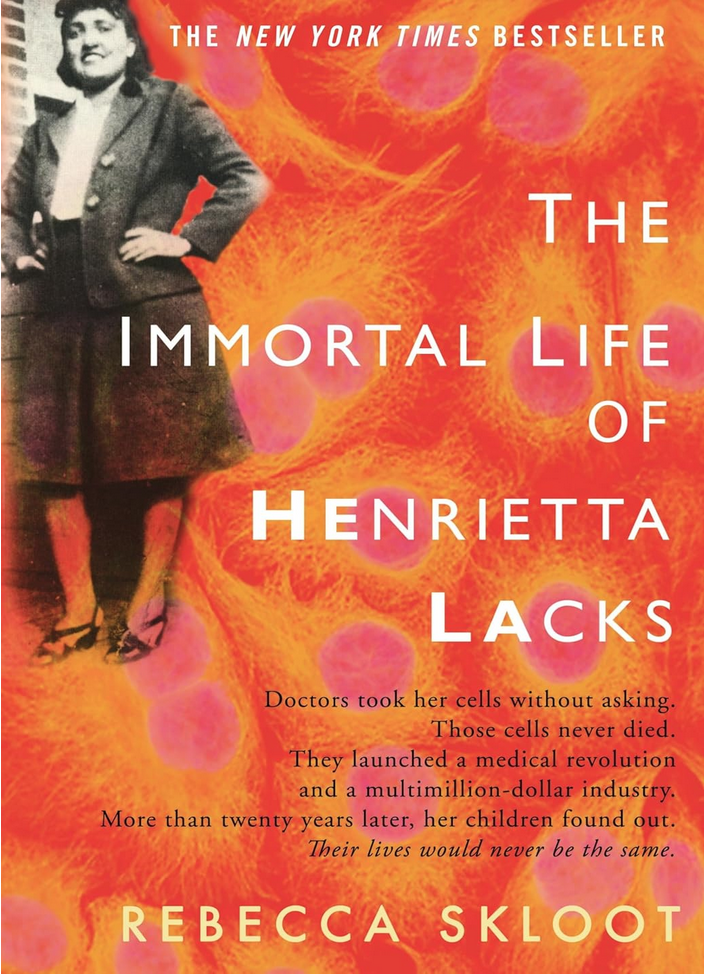
Her name was Henrietta Lacks, but scientists know her as HeLa. She was a poor Southern tobacco farmer who worked the same land as her slave ancestors, yet her cells—taken without her knowledge—became one of the most important tools in medicine: The first “immortal” human cells grown in culture, which are still alive today, though she has been dead for more than sixty years. HeLa cells were vital for developing the polio vaccine; uncovered secrets of cancer, viruses, and the atom bomb’s effects; helped lead to important advances like in vitro fertilization, cloning, and gene mapping; and have been bought and sold by the billions.
Yet Henrietta Lacks remains virtually unknown, buried in an unmarked grave.
Henrietta’s family did not learn of her “immortality” until more than twenty years after her death, when scientists investigating HeLa began using her husband and children in research without informed consent. And though the cells had launched a multimillion-dollar industry that sells human biological materials, her family never saw any of the profits. As Rebecca Skloot so brilliantly shows, the story of the Lacks family—past and present—is inextricably connected to the dark history of experimentation on African Americans, the birth of bioethics, and the legal battles over whether we control the stuff we are made of.
Over the decade it took to uncover this story, Rebecca became enmeshed in the lives of the Lacks family—especially Henrietta’s daughter Deborah. Deborah was consumed with questions: Had scientists cloned her mother? Had they killed her to harvest her cells? And if her mother was so important to medicine, why couldn’t her children afford health insurance?
Intimate in feeling, astonishing in scope, and impossible to put down, The Immortal Life of Henrietta Lacks captures the beauty and drama of scientific discovery, as well as its human consequences.
Challenges & Bans
This book has been challenged primarily for its graphic content, with some parents deeming it too violent and sexually explicit, particularly the descriptions of Henrietta Lacks’ cancer diagnosis and treatment. Other challenges have also included concerns about the book’s discussions on race, bioethics, and scientific exploitation, as well as the complex and controversial issues of informed consent and the commercialization of human tissue
Specific Challenges*:
Knox County School District, Tennessee (2015/16): Challenged as a summer reading assignment at the 15 high schools in the KCSD system because a parent claimed the nonfiction book “has too much graphic information” and called it “pornographic”. As a result, the reading assignment was changed to a different book, but the book was allowed to remain in libraries at the high school level.
*Source: Marshall University Library Banned Books webpage
Awards & Accolades
#1 New York Times Bestseller, Essence’s 50 Most Impactful Black Books of the Past 50 Years, Chicago Tribune Heartland Prize for Nonfiction (winner), Kirkus Reviews Best Nonfiction Book of the Century
Books of the Decade Lists Named to: CNN (“most influential”), Lithub (“defining”), The Philadelphia Inquirer (“best”)
Best Book of the Year Lists: The New York Times Book Review, Entertainment Weekly, O: The Oprah Magazine, NPR, Financial Times, New York, Independent (U.K.), Times (U.K.), Publishers Weekly, Library Journal, Kirkus Reviews, Booklist, Globe and Mail
